Playbook PM: Barr doesn’t expect ‘criminal investigation’ of Obama, Biden

Presented by Blue Cross Blue Shield Association: POLITICO's must-read briefing on what's driving the afternoon in Washington
May 18, 2020 View in browser
 
POLITICO Playbook PM

By Jake Sherman, Anna Palmer, Garrett Ross and Eli Okun

Presented by

NEW … FLAGGING FOR THE WEST WING … Since JEFF SESSIONS resigned as A.G., he has earned $108,000 making speeches, according to a financial disclosure form filed with the Senate. One interesting speech: SESSIONS was paid $24,000 by SKYBRIDGE CAPITAL, ANTHONY SCARAMUCCI'S hedge fund. It was, by far, his priciest speech. It appears the fee was for SESSIONS' appearance at SCARAMUCCI'S SALT Conference in Las Vegas. He got between $8,000 and $16,000 for his other speeches. The disclosure

A.G. BILL BARR this morning: "As to President Obama and Vice President Biden, whatever their level of involvement, based on the information I have today, I don't expect Mr. Durham's work will lead to a criminal investigation of either man. Our concern over potential criminality is focused on others."

THE PURGE: ELECTION YEAR -- ANDREW DESIDERIO: "Fired watchdog was investigating Trump administration arms sales to Saudi Arabia": "The revelation adds another layer to Trump's decision to sack Steve Linick, who was also looking into claims that Secretary of State Mike Pompeo and his wife improperly directed political appointees to run personal errands for him." POLITICO

-- WAPO'S CAROL MORELLO (@CMorelloWP): "Secretary of State Mike Pompeo says in interview fired inspector general 'wasn't performing a function in a way that we had tried to get him to' and was 'trying to undermine what it was that we were trying to do.'"

VACCINE LATEST -- "Moderna's coronavirus vaccine shows encouraging early results in human safety trial," by WaPo's Carolyn Johnson: "The company plans to launch a large clinical trial in July aimed at showing whether the vaccine works. The company reported that in eight patients who had been followed for a month and a half, the vaccine at low and medium doses triggered blood levels of virus-fighting antibodies that were similar or greater than those found in patients who recovered. That would suggest, but doesn't prove, that it triggers some level of immunity.

"Moderna's announcement comes days after one of its directors, Moncef Slaoui, stepped down from the board to become chief scientist for Operation Warp Speed, a White House initiative to speed up vaccine development. Watchdogs called out Slaoui's apparent conflict of interest, noting he owns Moderna stock options worth $10 million." WaPo

HHS SECRETARY ALEX AZAR, appearing on FOX NEWS this morning, on PETER NAVARRO dumping on the CDC during the Sunday shows: "The comments regarding the CDC are inaccurate and inappropriate."


A message from Blue Cross Blue Shield Association:

Maintaining access to affordable health insurance is critical, especially today. See our proposals to ensure Americans stay covered, providing security when they need it most.


AS THE U.S. TURNS INWARD … "China announces $2 billion in virus help at WHO assembly," by AP's Jamey Keaten in Geneva and Maria Cheng in London: "The European Union's 27-member bloc and other countries, meanwhile, called for an independent evaluation of WHO's initial response to the coronavirus pandemic 'to review experience gained and lessons learned.' …

"The $2 billion over the next two years will support COVID-19 response efforts, including economic and social development, particularly in developing countries, Xi [Jinping] said. … Xi said he also supports the idea of a comprehensive review of the global response to COVID-19." AP

-- "Chinese vaccine would be 'global public good,' Xi says," by Sarah Wheaton

TERRORISM TRACKER -- "FBI finds al Qaeda link after breaking encryption on Pensacola attacker's iPhone," by CNN's David Shortell and Evan Perez: "The Saudi military trainee who killed three US sailors and wounded several others in a terror attack last year on a military base in Pensacola, Florida, was in touch with a suspected al Qaeda operative, according to multiple US officials briefed on the matter. …

"A breakthrough on the shooter's phone encryption for now temporarily disarms a standoff between the Justice Department and Apple over national security and the limits of encryption and privacy. … If [Mohammed] Alshamrani was directed or trained by al Qaeda, it would mark the first time since 9/11 that a foreign terrorist organization had done so in a deadly attack in the US, according to New America." CNN

Good Monday afternoon.

OVERSIGHT PANEL REVS UP -- "Bipartisan commission offers blueprint for Fed, Treasury oversight," by Victoria Guida: "A congressional commission charged with supervising hundreds of billions of dollars in emergency lending programs for businesses and municipalities on Monday provided a blueprint into where it will focus its oversight efforts.

"Among the more than 50 questions posed in its first report, the bipartisan panel pressed the Federal Reserve and Treasury Department on how they will measure the success of those lending programs." POLITICOThe report

-- WAPO'S ERICA WERNER: "$500 billion Treasury fund meant for coronavirus relief has lent barely any money so far, oversight commission finds"


JOIN TOMORROW – HOW DO WE STRATEGICALLY REOPEN THE ECONOMY? Join chief economic correspondent Ben White tomorrow at 9 a.m. EDT for a virtual conversation with Rep. Andy Kim (D-N.J.), to discuss his work on the newly launched House Select Committee on the Coronavirus Crisis and whether he believes that the fiscal response so far has been enough. Should there be more transparency on how stimulus dollars are being spent? What more does Congress need to do to keep the economy afloat? Have questions? Submit yours by tweeting it to @POLITICOLive using #AskPOLITICO. REGISTER HERE.


REALITY CHECK from JOANNE KENEN: "'Immunity passports' won't reopen America": "The problem is many of the more than 120 tests on the market are inaccurate. And scientists don't really yet understand how much immunity antibodies confer or how long it lasts. But these tests — and the apps to promote them — are gaining traction among businesses and consumers eager to know who has been exposed to the virus, raising the risk that people will be relying on faulty results to promote their immunity from the coronavirus. …

"Eventually, tools that help identify who is at less risk might be useful for redesigning workplaces or figuring out which member of a family is safest navigating the wider world. … But businesses or organizations that rush to use them to promote safety and recovery can get it badly wrong — especially without government guidelines." POLITICO

IMMIGRATION FILES -- "Immigration courts in 'chaos,' with coronavirus effects to last years," by SF Chronicle's Tal Kopan: "[M]any of those who work in the system say the Trump administration has handled the shutdown in an especially haphazard manner, increasing the stress on judges and attorneys in addition to immigrants and making it harder for the courts to bounce back. … The Justice Department began postponing hearings for immigrants who are not in detention on March 18, and the delays have been extended every few weeks. Hearings are now set to resume June 15.

"But many courts technically remain open, including the one in San Francisco, with frequently changing statuses announced on social media and a website. … The scattershot communications make it difficult to prepare for if and when the hearings are held, immigrants say. And it's worse for those who have no lawyer who can help navigate the changes. About one-third of immigrants with pending cases have no representation, according to Justice Department statistics, and missing a hearing is grounds for deportation." SF Chronicle

INDUSTRY IMPACTS -- "Auto plants reopen but industry could still need U.S. aid," by Sabrina Rodríguez: "If automakers fail to successfully restart — and bring in some much-needed cash, it could mean the loss of thousands of jobs and an economic crisis for the industry integral to North America. And it could force Congress and the Trump administration to step in with money." POLITICO

CLICKER -- "Where Chronic Health Conditions and Coronavirus Could Collide," by NYT's Nadja Popovich, Anjali Singhvi and Matthew Conlen

BEYOND THE BELTWAY -- "Ohio's Amy Acton inspires admiration, and a backlash, with tough coronavirus response," by WaPo's Griff Witte: "To her legions of fans, she's a hero whose aggressive action as Ohio health director has saved lives, and whose calm, clear and compassionate style is a national model for how leaders should be communicating amid an unparalleled public health crisis. Yet Acton has also become a target, and not only for the protesters — some armed, most not — who have descended on her home." WaPo


GO BEYOND OUR BORDERS FROM YOUR HOME: Global Translations, presented by Bank of America, is the only newsletter focused on essential global news, trends and decisions layered with critical contextual analysis from the sharpest minds around the world. From how countries are dealing with economic crisis, to technology advances, trade challenges and climate change, Global Translations offers a unique perspective that cannot be found anywhere else. SUBSCRIBE TODAY.


WHAT FOGGY BOTTOM IS READING -- DEEP DIVE: "The Twilight of the Iranian Revolution: For decades, Ayatollah Khamenei has professed enmity with America. Now his regime is threatened from within the country," by The New Yorker's Dexter Filkins

VOTING WATCH -- "Freed by Court Ruling, Republicans Step Up Effort to Patrol Voting," by NYT's Michael Wines: "Six months before a presidential election in which turnout could matter more than persuasion, the Republican Party, the Trump campaign and conservative activists are mounting an aggressive national effort to shape who gets to vote in November — and whose ballots are counted. …

"The Republican program, which has gained steam in recent weeks, envisions recruiting up to 50,000 volunteers in 15 key states to monitor polling places and challenge ballots and voters deemed suspicious. That is part of a $20 million plan that also allots millions to challenge lawsuits by Democrats and voting-rights advocates seeking to loosen state restrictions on balloting. The party and its allies also intend to use advertising, the internet and President Trump's command of the airwaves to cast Democrats as agents of election theft.

"The efforts are bolstered by a 2018 federal court ruling that for the first time in nearly four decades allows the national Republican Party to mount campaigns against purported voter fraud without court approval." NYT

HUAWEI OR THE HIGHWAY -- "Huawei Warns U.S. Chip Ban Will Damage Operations Globally," by WSJ's Dan Strumpf: "Calling the move 'arbitrary and pernicious,' Huawei in a statement issued Monday said the rule 'will impact the expansion, maintenance and continuous operations of networks worth hundreds of billions of dollars that we have rolled out in more than 170 countries.'" WSJ

2021 PROMISES -- "Biden White House would yank Keystone XL permit," by Ben Lefebvre

MEDIAWATCH -- Emma Dumain is joining E&E News as a Congress reporter. She currently is a Congress reporter for The State/McClatchy.

WEEKEND WEDDING -- Michael Del Moro, a booking producer for MSNBC's "Morning Joe," and Alec Vlaho, an OB-GYN medical resident at Rutgers University Hospital and St. Barnabas Hospital, got married Saturday in Brick Township, N.J. They had originally planned a large wedding, but instead kept it to (socially distanced) immediate family and postponed the reception to 2021. Pics

WELCOME TO THE WORLD -- Zach Pfister, policy director at Brownstein Hyatt Farber Schreck, and Brittany Pfister, interim chief development officer at Americans United for Separation of Church and State, welcomed Conrad Julian Pfister on Saturday. He came in at 9 lbs, 1 oz. Pic

BONUS BIRTHDAY: Univision White House correspondent Janet Rodriguez (h/t Anthony Cruz)


Advertisement Image


Follow us on Twitter

Anna Palmer @apalmerdc

Jake Sherman @JakeSherman

Eli Okun @eliokun

Garrett Ross @garrett_ross


Subscribe to the POLITICO Playbook family

Playbook  |  Playbook PM  |  California Playbook  |  Florida Playbook  |  Illinois Playbook  |  Massachusetts Playbook  |  New Jersey Playbook  |  New York Playbook  |  Brussels Playbook  |  London Playbook

View all our politics and policy newsletters

Follow us

Follow us on Facebook Follow us on Twitter Follow us on Instagram Listen on Apple Podcast
 

To change your alert settings, please log in at https://login.politico.com/_login?base=https%3A%2F%2Fwww.politico.com

This email was sent to ateebhassan000.ravian@blogger.com by: POLITICO, LLC 1000 Wilson Blvd. Arlington, VA, 22209, USA

Please click here and follow the steps to unsubscribe.

Groups of up to six people from two different households are now permitted to meet outdoors - anyone over the age of five in Northern Ireland can be tested for COVID-19

71 confirmed outbreaks of COVID-19 in NI care homes - another 33 suspected outbreaks


  May 18, 2020  


Dear reader

Northern Ireland is now making its first big moves towards easing lockdown.

Not only did recycling centres open on Monday to queues, garden centres are now accepting customers. 

Tomorrow we report on further details of the relaxation, including the fact that the outdoor sports golf and tennis can now be played, and churches will be opened for solitary prayer. 

The most significant change of all, however, is that outdoor gatherings of four to six people from outside the same household will be allowed. But there will be no indoor gatherings of family members.

Also in Tuesday's paper, we report on how agricultural college accommodation in Enniskillen and Greenmount has been used by NHS workers.

And our business section tells of a Ballyclare homebuilder. Hagan Homes, who will apply a £5,000 discount to properties at its Thirty Three South development in Belfast for those working in the NHS during the coronavirus crisis.

I hope you all enjoy your day.

Stay safe

Ben Lowry

Deputy editor


Today's latest news:
 

Six more deaths of people with COVID-19 in NI - death toll now 482 
According to the Department of Health figures all six people died within the previous 24 hours
Another 16 people tested positive for coronavirus in NI.

See the latest Department of Health report

The Stormont Executive should be more 'optimistic and ambitious' about trialling some form of return to school before the end of June, Jim Allister has said
The TUV leader's call came after England's former education secretary Lord Blunkett said that English teaching unions were working against the interests of children in opposing plans to reopen schools next month.
The British and Irish Group of Teacher Unions (BIGTU) has written to Stormont Education Minister Peter Weir urging "significant caution" before schools open, arguing that a premature reopening is too great a risk.
"We are convinced by the experience of other systems that a critical tool in preventing a surge of infection is an established capacity to 'test trace and isolate; and we would argue that reopening schools before such a regime is in place would be catastrophic to the rate of infection," they said.
But Lord Blunkett has now come out against similar opposition in England, saying he was "deeply critical" of their approach towards attempts to open schools in England on June 1.

Everyone in the United Kingdom over the age of five can now be tested for COVID-19, Secretary of State for Health and Social Care, Matt Hancock, has told the House of Commons 
The expansion of testing to everyone over the age of five was agreed by authorities in Northern Ireland, England, Scotland and Wales.
First Minister of Scotland, Nicola Sturgeon, confirmed Scotland had adopted the change during a press conference on Monday however Health Secretary, Matt Hancock, confirmed the policy applied to all four parts of the UK.
"Everyone aged five and over with symptoms is now eligible for a test," Mr. Hancock told the House of Commons on Monday.

A loss or changed sense of taste or smell are to be added to the NHS coronavirus symptoms list, weeks after experts first raised concerns that Covid-19 cases are being missed 
Anyone suffering loss of taste or smell, or a noticeable change, should now self-isolate for seven days to reduce the risk of spreading the infection, England's deputy chief medical officer, Professor Jonathan Van-Tam said.
If the symptomatic person lives with others, they should stay at home for seven days, while all other household members should stay home for 14 days even if they do not have symptoms.
The move means loss of smell or taste will now be listed alongside fever and cough as the main symptoms of Covid-19.


  LIVE BLOG Coronavirus NI: Groups of up to six people from two different households now PERMITTED to meet outs doors - anyone over the age of five in Northern Ireland can be tested for COVID-19  
     
  The Northern Ireland Executive is now permitting groups of up to six people from two different households to meet up as long as it is outdoors, First Minister, Arlene Foster, has confirmed.  
     
{$escapedtitle}


Article Image
Loss of smell or taste added to NHS Covid-19 symptoms list
 
A loss or changed sense of taste or smell are to be added to the NHS coronavirus symptoms list, weeks after experts first raised concerns that Covid-19 cases are being missed.


Article Image
Six more deaths of people with COVID-19 in NI - death toll now 482 - see how many people have died and how many have tested positive with the virus
 
Another 6 people have died in NI after testing positive for COVID-19.


Article Image
Post-lockdown queues at Belfast recycling centres
 
The queue for a recycling facility in Belfast started at 7am on Monday as Northern Ireland took its first steps out of the coronavirus lockdown.


You have received this email as you have an account on the News Letter, published by JPIMedia Publishing Ltd. To manage your individual newsletter preferences with the with us, please click here and log in to your account.
 
 
Alternatively you can update your email preferences to choose the types of emails you receive from JPIMedia Publishing Ltd, or unsubscribe from all future emails.


JPIMedia Publishing Ltd, a company registered in England and Wales with registered number 11499982, having its registered address at Third Floor, 1 King William Street, London, England, EC4N 7AF, United Kingdom.

We will process your personal data in accordance with our privacy policy.
 

California Today: Why Researchers Hope to Test High-Risk Groups

California has lagged in Covid-19 testing.
0

By Max Brimelow, Julie Chang, Pedro Cota, Alex Matthews and Kristen Hwang

Diane del Pozo administered a test for Covid-19 to Ollie Harris at an Oakland homeless camp last month. His test was among the first in a new partnership between a local health clinic and U.C. Berkeley’s Innovative Genomics Institute.Pedro Cota

Good morning.

(If you don’t already get California Today by email, here’s the sign-up.)

Today, we have another dispatch from the University of California, Berkeley Graduate School of Journalism, written by Max Brimelow, Julie Chang, Pedro Cota, Kristen Hwang and Alex Matthews:

OAKLAND — In his 20 years in and out of homelessness, Ollie Harris, 69, has seen a lot of things. But what happened on a recent Friday was new.

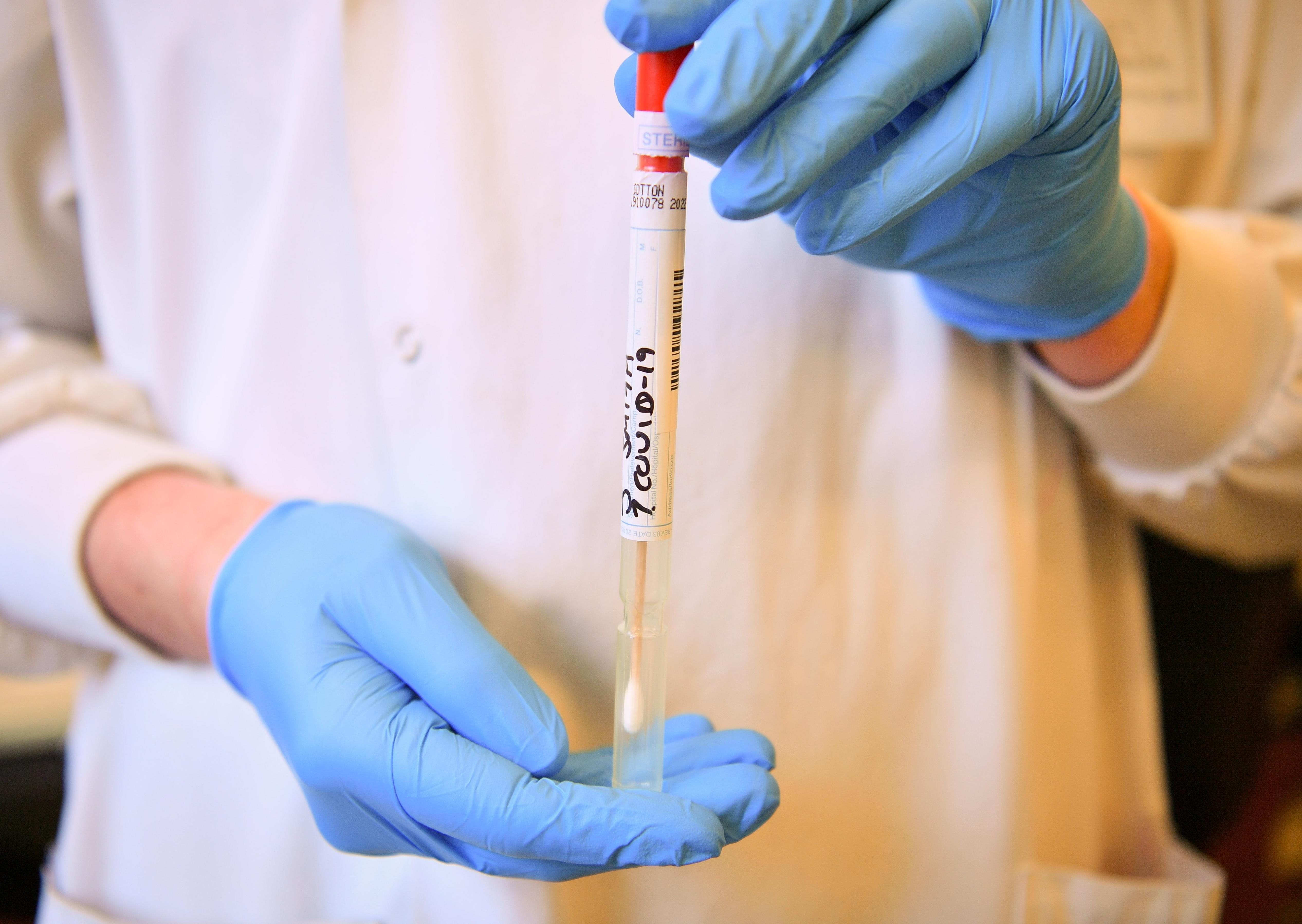
Sitting outside his tent on a patch of ground he and his wife staked out near Lake Merritt, he watched a white van pull up and two women step out wearing surgical masks and latex gloves.

“Would you like to be tested today?” one of them asked. “I might as well,” Mr. Harris replied. A nurse quickly swabbed Mr. Harris’s nostrils and throat and then jotted down his information.

Mr. Harris was one of the first people tested under a new type of collaboration that has emerged as a distinctive feature in California’s fight against Covid-19.

So far at least six new testing initiatives are led by health experts at California’s top public and private universities. They aim to fill gaps in knowledge about the disease’s prevalence, unravel mysteries about survivor immunity and answer other looming questions as California begins to ease its lockdown.

ADVERTISEMENT

Some universities are working independently, others in partnerships with county health departments and community clinics. Most are developing their plans on the fly as they race to get ahead of the fast-moving virus. So far, their work has raised as many questions as it has answered. But there have also been intriguing, if still tentative, findings.

The initiative that tested Mr. Harris, for example, has found just four positive cases out of the 233 homeless people it has tested so far. Another initiative found stark contrasts in infection rates based on whether a person was able to work from home or not. Other university-led studies suggest California remains a long way off from achieving the sort of herd immunity that would slow the virus’s transmission from a gallop to a crawl.

[See which California counties have the most coronavirus cases.]

The university health experts leading these efforts said they acted to fill a void. Eva Harris, an infectious disease specialist at the University of California, Berkeley, said that watching the virus spread around the world while bickering government leaders hesitated to act was like witnessing the Titanic speeding toward the iceberg. “We finally just said, ‘OK, it hit,’ and still nothing happened, so we need to get involved,” she said.

ADVERTISEMENT

While governments at every level and in every region of the United States have struggled to provide enough testing, California has been notably sluggish.

The first known Covid-19 death in the United States happened on Feb. 6 in Santa Clara County. Three months later, government testing in the state remains spotty, in part because of its decentralized and tangled network of test providers spread across a population of 40 million. While California now conducts more than 30,000 tests per day — compared with a few hundred a little more than a month ago — only 26 of every 1,000 Californians have been tested, ranking the state 26th in the nation.

Among the vast numbers of the untested are many high-risk groups, but none more so than the 150,000 homeless people living throughout California. Their encampments, often crowded and lacking basic sanitation, could provide a place for the virus to flourish or rekindle.

One of the most aggressive efforts currently underway to examine the extent of infection in homeless encampments is being led by the Innovative Genomics Institute, a biochemistry lab at the University of California, Berkeley, best known for its work at the forefront of the CRISPR gene-editing process, and Lifelong Medical Care, a community health center also based in Berkeley. The two have begun expanding testing to low-income and homeless populations in Alameda County, including the test given to Mr. Harris at the Lake Merritt camp.

The institute offered Lifelong high-speed automated processing of 5,000 tests, with more to come. Lifelong, which serves about 66,000 patients, had performed fewer than 300 diagnostic tests before the partnership.

ADVERTISEMENT

“If we can’t help the vulnerable, what are we doing?” asked Fyodor Urnov, the institute’s scientific director for technology and translation.

Not far from Dr. Urnov’s office on the Berkeley campus, two professors in the School of Public Health have teamed up for a different kind of study. Dr. Harris, the infectious disease expert, and Lisa Barcellos, a genetic epidemiologist, are investigating the infection’s spread throughout the Bay Area.

They are testing thousands of residents to look for the presence of active Covid-19 virus as well as antibodies in the blood. This could reveal patients who were exposed but never showed symptoms, and it could also shed light on how widespread the disease truly is in California.

The University of Southern California and Stanford University recently released preliminary results of their own antibody studies estimating that between 2 percent to 5 percent of the populations of Los Angeles County and Santa Clara County have been infected, higher than previously believed, but also a potential indicator that California is far away from achieving any possible herd immunity.

However, both studies continue to draw attacks over unconventional methodologies, including the use of a test kit that is not approved by the Food and Drug Administration.

As first reported by BuzzFeed News, the Stanford study is now under scrutiny for not disclosing a potential conflict of interest.

One of the larger testing efforts comes from the University of California, San Francisco’s Division of Infectious Diseases, which, in collaboration with community organizations and local health departments, recently concluded testing of nearly 5,000 people in two different communities — the largely upscale oceanfront town of Bolinas in Marin County, and the Mission District in central San Francisco.

The two studies used diagnostic and antibody tests to understand how the virus moves through rural versus urban populations.

[What are your chances of catching the virus outdoors? Here’s what to know.]

U.C.S.F. chose the Mission because the community’s Latinx population was hit hard in the initial outbreak. Bolinas became part of the university’s research focus when two of its residents, Cyrus Harmon, a biotech executive, and Jyri Engeström, a venture capitalist, proposed to get every person in their town tested. When they consulted U.C.S.F. for guidance, they were brought into the university’s Covid-19 testing program for comparison with the Mission study.

Initial results released in early May correlate the highest infection rates to low-wage and essential workers who, for economic reasons, have no choice but to work outside the home.

Of the 2,959 people tested in the Mission, 62 tested positive. Of those who tested positive, 90 percent said they were unable to work from home and nearly as many said they earn less than $50,000 a year. Ninety five percent of those who tested positive were Latinx, although only 44 percent of the overall sample were Latinx.

Of the 1,845 people tested in Bolinas, none tested positive.

“The virus exploits pre-existing vulnerabilities in our society,’’ Diane Havlir, a physician involved in the U.C.S.F. study, said.

California Today goes live at 6:30 a.m. Pacific time weekdays. Tell us what you want to see: CAtoday@nytimes.com. Were you forwarded this email? Sign up for California Today here and read every edition online here.

Jill Cowan grew up in Orange County, went to school at U.C. Berkeley and has reported all over the state, including the Bay Area, Bakersfield and Los Angeles — but she always wants to see more. Follow along here or on Twitter.

California Today is edited by Julie Bloom, who grew up in Los Angeles and graduated from U.C. Berkeley.

Need help? Review our newsletter help page or contact us for assistance.

You received this email because you signed up for California Today from The New York Times.

To stop receiving these emails, unsubscribe or manage your email preferences.

Subscribe to The Times

|

Connect with us on:

facebooktwitterinstagram

Change Your Email|Privacy Policy|Contact Us

The New York Times Company. 620 Eighth Avenue New York, NY 10018