Good morning! I'm finally about to lock in some last-minute travel plans for the summer, and there's likely a lot of flying in the near future. I always pack the same snacks (think nut and seed mixes, protein bars, and maybe a sliced apple) and am looking for recommendations to mix things up! What's your favorite snack to travel with? Let me know by replying to this email. — Molly Knudsen M.S., RDN, editor |
Lower your resting heart rate with omega-3s
|
Your heart rate reveals a lot about your health—and an elevated resting heart rate (RHR) is actually a risk factor for heart problems (think hypertension, plaque buildup, and even heart failure) and even early death. Aerobic exercise like endurance zone 2 training1 and HIIT2 are science-backed ways to lower your RHR, but so is eating omega-3 fatty acids like EPA and DHA—most notably found in fatty fish. How do omega-3s impact heart rate? - They appear to help lower heart rate by acting on the electrical excitability of heart tissue cells.
- Electrical impulses stimulate the heart to pulse, and omega-3s seem to increase the time between those electrical impulses3, therefore decreasing your heart rate.
What's considered a high RHR? - A "normal" resting heart rate falls between 60 and 904 (sometimes up to 100) beats per minute (bpm).
- Anything over 100 beats per minute is high, but even being at the upper end of the normal range may not be ideal for you.
How much can fish oil lower your heart rate? - Data indicate that on average, fish oil can decrease heart rate by 1.6 bpm5 compared to placebo.
- Another study found that a 1,000 milligram higher intake of fish oil intake reduced RHR by about 2.3 bpm.6
- And high fatty fish intake of five or more servings per week was linked to a 3.2 bpm reduction in RHR.6,7
- Benefits are most pronounced after at least 12 weeks of consistent intake and for those with a higher RHR (69+ bpm) to start.
- Lots of factors (age, fitness level, stress, genetics, medications, etc.) influence your RHR, and, increasing omega-3s is only one of many approaches you can take to try to lower it.
How to up your omega-3 intake - Eat more fatty fish: Eating 5+ servings of fatty fish every week may not be palatable or within budget for everyone and that's ok. If you do like fish, eating at least two servings of salmon, anchovies, sardines, or tuna a week is a good place to start.
- Try a supplement: Supplements can be an easy way to significantly increase your omega-3 intake. For the most benefit (heart rate and overall heart health), consider supplementing with 1,000-2,000 milligrams a day.
+ The pulse |
The chopping block: Is green tea only good for heart health?
|
There's no debate that green tea is good for you. These leaves are particularly rich in flavonoids called catechins—especially epigallocatechin gallate or EGCG—which are often cited as the reason why green tea has such positive effects on heart health. But these catechins are also great for dental health. Yep, green tea is also great for your teeth. Here's why:8,9 - It inhibits the growth of harmful, toxin-producing bacteria in your mouth
- It helps protect the tooth socket (a sign of gum disease and may lead to loose teeth).
- It's antioxidants fight inflammation that leads to gum disease
- It improves bad breath
How much do you need? - Most research shows drinking 3-5 cups (24-40 ounces) of brewed green tea daily is best for health
- For the best results, brew green tea at a temperature of 160-170°F for 1-3 minutes
- Some studies also show it's beneficial as a mouthwash
+ More reasons to go green |
|
| How I went from eating 60 to 100 grams of protein daily |
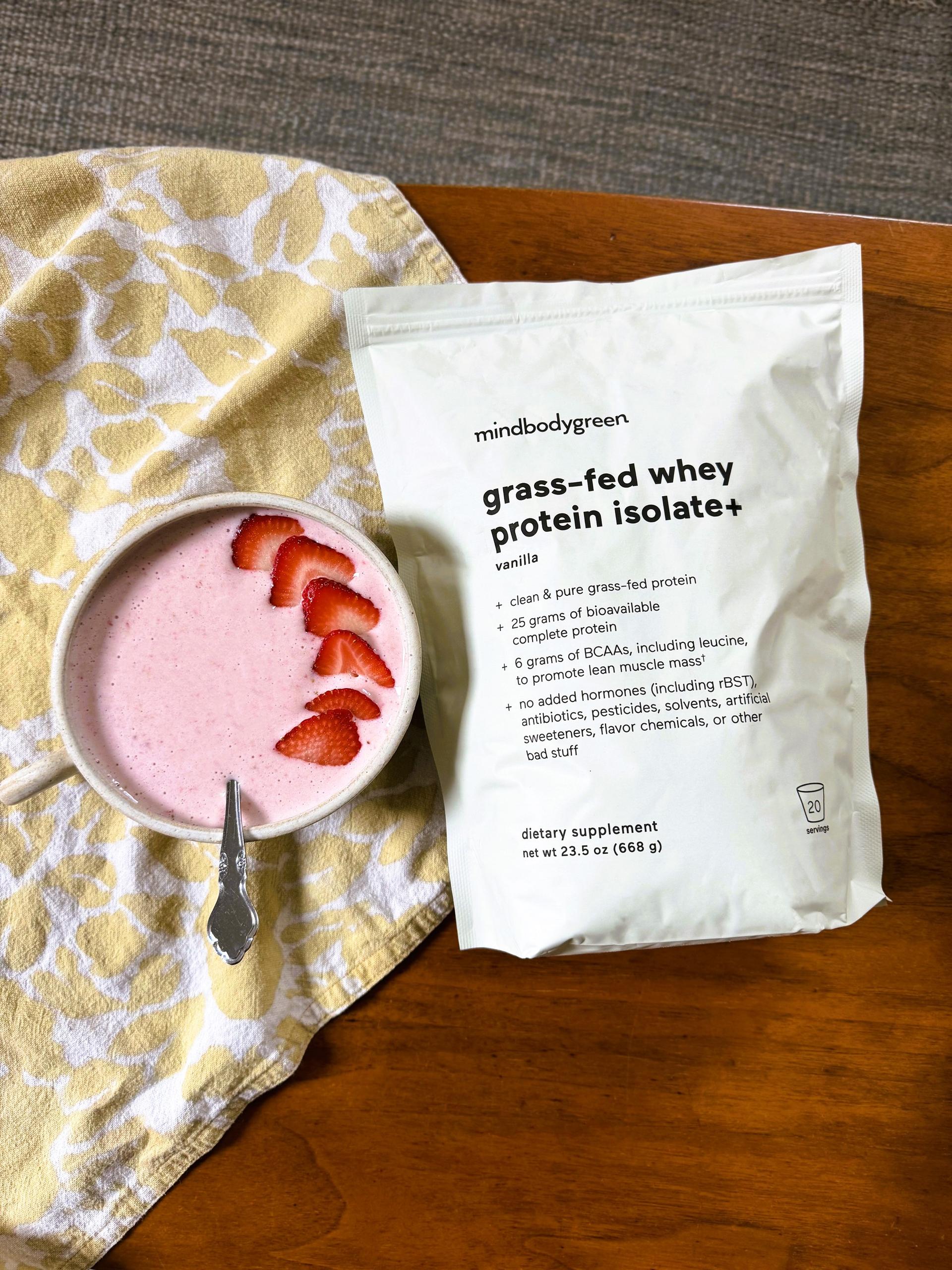
Late last year, as I was interviewing experts for mindbodygreen's 2024 Well-Being Forecast (which predicted that the high-protein movement would challenge toxic diet culture), I got a brutal wake-up call. I definitely wasn't reaching my daily protein needs. At the time, I was eating about 60-75 grams of protein a day, but I really needed an additional 30-40 grams a day. So here's what I did. - Breakfast: For breakfast, I tend to like something carby. So I leaned into a lot of Greek yogurt, nuts, seeds, and grass-fed whey protein isolate+. This was my first time trying a whey protein powder, and I loved how it added an extra 25 grams (!) of protein to whatever I was eating—mainly overnight oats and yogurt. This protein powder leaves out all the junk that litters so many other products, and the vanilla flavor is truly delicious.
- Lunch: I tend to be pretty lazy for this meal. To hit my protein threshold, I loved tossing a can of salmon or tuna (34 grams of protein) into a big salad. Or I would do a midday breakfast variation with scrambled eggs and a fruit smoothie (featuring the whey protein of course).
- Dinner: For dinner, I would whip up an easy chicken-thigh sheet-pan dish, shrimp tacos, a fish filet, or a tofu stir fry.
I felt so good during this experiment, that I'm still keeping up this eating pattern—which is easier than I thought thanks to my grass-fed whey protein isolate+. I have at least one serving a day, and it's quickly turned into a pantry staple. Are you ready to try the high-protein life? |
|
|
Ok, we clearly know that a diet of rabbit food isn't sustainable for humans (there's no way you'll hit your protein needs with it). But leafy greens are a great addition to any meal. And with farmers markets in full swing, there's no shortage of variety. Some greens are peppery and tangy (like watercress) while others are mild and delicate (like spinach). You can toss them in a smoothie, mix and match them in a salad, layer them in a sandwich, sauté them on the stove, or blend into a sauce. The options are endless! + Delicious leaves |
Unwinding after work sans alcohol
|
Is it just me, or are the later and later sunsets creating the perception of having more free time in the evenings? These days, I'm so motivated to get out of the house on weeknights and meet up with friends, but I can't sustain a schedule of having alcohol be the center of these gatherings. If you're also looking to unwind in an alcohol-free way, then it's time to embrace mocktails. Many bars and restaurants now have a mocktail menu of hydrating, creative concoctions so you don't have to give up that sweet, tangy, or herbaceous part of the beverage that you love. Or if you're hosting, consider whipping up or providing one of + In our mocktail era |
Need an answer? Drop me your questions here. That's it for this week! Until next time, bon appétit. –Molly Knudsen, M.S., RDN |
Want more from mindbodygreen? Find us here: |
 | | | | Forwarded by a friend? Subscribe here! | | © 2024 mindbodygreen, All rights reserved.
2980 McFarlane Road, Miami, FL 33133
UNSUBSCRIBE
| | | | | |
|
|
|





No comments:
Post a Comment