IS struggle to make progress in Taliban bastion Afghanistan


KHOGYANI: The self-styled Islamic State (IS) group had ambitious plans for Afghanistan, but Taliban resistance, US drone strikes, and a society less scarred by sectarianism mean the extremists have so far failed to repeat their Middle Eastern breakthrough.
The jihadist group, which controls large areas of Syria and Iraq, has been trying for months to establish itself in Afghanistan's eastern badlands, challenging the Taliban on their own turf.
Its franchise in the war-torn country has managed to recruit disaffected Taliban fighters, as the fractious Afghan militant movement wrestles with a bitter power transition.
But the loss of senior commanders in drone strikes and the group's signature brutality, which repels many Afghans, has helped stem its advance.
Frequent clashes and firefights with Taliban insurgents have also hampered its bid to capture significant territory.
"In Iraq and Syria, you might say (IS) are in stage six or seven or eight," top US military officer General Martin Dempsey said last month. "In Libya, they are in stage three or four, and in Afghanistan they are in stage one or two."
His views are echoed by other NATO officials who say that IS in Afghanistan are not yet capable of carrying out the sort of coordinated operations they are conducting in Iraq and Syria, although the potential exists for them to evolve into a bigger threat.

IS: flavour of the month?

Some Taliban insurgents, particularly in the restive eastern provinces of Kunar and Nangarhar, have adopted the IS flag to rebrand themselves as a more lethal force as NATO troops depart after 14 years of war.
The risk of defections grew after the July announcement of Mullah Omar's demise, with many angry Taliban fighters accusing the leadership of covering up the supremo's death for two years.
Some top cadres including Omar's son and brother have refused to pledge allegiance to new leader Mullah Akhtar Mansour, saying the process to select him was rushed and even biased.
"The Taliban have no redeeming features," said Mullah Mirwaos, a former Taliban militant who is now an IS commander in the Kajaki district in the southern province of Helmand.
Michael Kugelman, Afghanistan expert at the Washington-based Woodrow Wilson International Center for Scholars, said Islamic State is the "flavour of the month right now. It has a dramatic appeal to a lot of alienated militants."
But the Taliban are attempting to counter that, with an aggressive drive north from their southern and eastern strongholds, as well as a wave of fatal bombings in the Afghan capital, Kabul.
Experts say the escalating violence demonstrates Mullah Mansour's bid to boost his image within the Taliban, which could halt the defections to IS.
"The Taliban remain a formidable fighting force. It is in a position to fight back and push back against IS inroads," Kugelman said. "The Taliban has been able to keep IS at bay in eastern Afghanistan."

"IS are cruel"

US drone strikes in recent weeks have also dealt a significant blow to IS in Afghanistan, killing dozens of suspected cadres, including the group's Afghanistan-Pakistan regional chief Hafiz Saeed.
NATO spokesman Colonel Brian Tribus said IS is an "operationally emergent" group but the Taliban pose a "greater threat" to the Afghan government and foreign forces.
Crucially, beyond the battlefield the Taliban have been far more successful than IS in attracting the support of local Afghans. "Daesh (IS) militants are cruel — they kill without reason," explained a resident of the volatile district of Achin in eastern Nangarhar province bordering Pakistan.
The Taliban, who have themselves often been accused of savagery during their 14-year insurgency, are seeking to appear as a bulwark against IS's rein of brutality and as a legitimate group waging an Islamic war.
Earlier this month the Taliban condemned a "horrific" video that apparently showed IS fighters blowing up bound and blindfolded Afghan prisoners with explosives. "This un-Islamic act... can never be justified," the Taliban said.
One other reason IS have struggled to gain a firmer foothold in Afghanistan, Kugelman said, is because of the lack of a deeply sectarian environment. "It's sharp sectarian divides that IS is exploiting in Iraq and Syria," he said. "IS simply cannot use any sort of sectarian divide as traction to gain a foothold in the region. You simply don't have a sharp divide in Afghanistan."

Dear India, your policy on Pakistan is utterly obsolete

The national security advisors’ meet fiasco has led to some graver questions.
Are both sides losing control to the hardliners?
Are they even aware of the consequences of their actions?
Is there any reset button to undo the damage done?
It is my humble view that the Indian playbook on Pakistan is at least seven to eight years old. Meanwhile, the dangerous brinkmanship on the Line of (no) Control (LoC) continues unabated. The world watches with alarm and weariness, as there is no telling if and when the escalation may spiral out of control.
See it with the eyes of a common man like me, who calls Pakistan his home and has no other place to go to. The said man has to explain to his little kids why there are power outages all the time; why there is no Disney Land in the country or in the neighbourhood; why breaking news always brings to them bad news, angry news, sad news.
He has no suitable explanation for why grown-ups attacked a school in Peshawar, and snatched from many children their right to live and innocence from the rest. And yet, that father – whose job has transformed from sheltering the delicate world of his children to painstakingly elaborate to them one tragedy after another – doesn’t have a heart to explain how close they sit to the epicentre of a possible, if not probable, nuclear holocaust; that the miscalculation of a single day can snatch from them their bright future, their health, their environment and perhaps even their beautiful forms.
Imagine the burden. The anguish and suffocation. I am sure this sense of helplessness is shared on the other side of the border.

Our legacy of hate

India and Pakistan have many things in common. Chief among them is hate. Both have extremist tendencies among their religious majorities, and yet both take incredible pains to blame it on their minorities. In India, Muslims and Christians must be responsible for everything bad. In Pakistan, it must be those wily Ahmadis, Hindus and Christians.
Both countries teach their own versions of history in schools. Recently, a significant amount of hate has been identified in Pakistani school curricula, but that is only the tip of the iceberg. Hatred in both countries does not flow from these books, considering that both states have miserably failed to educate their masses (although this problem also needs to be fixed too).
The real hatred flows from their respective interpretations of history, which finds many mediums to propagate; oral tradition, popular culture, religious discourse and even fairytales when they reach us in our mothers’ laps or in the cradle.
After three generations, the indoctrination is almost complete. And sadly, the underlying motivation is not any vicious conspiracy but the insecurity of the two states. India, which lost Pakistan in 1947, fears this can happen again and Pakistan may foment unrest there. Pakistan has always thought India is out to get it. Both have some reasons to feel suspect each other.
However, when the paranoia, hatred and craziness has reached this height, you know you have to roll back this industry.
The region can no longer afford the Abhinav Bharats and the Lashkars anymore. This has to stop. History is important but not important enough to demand future in ransom. Time is the worst place to get lost into.

Indian misperceptions about Pakistan

1. Pakistan will implode soon
During my last visit to India, I felt that a very distorted view of Pakistan is prevalent there.
Indian intelligentsia perhaps inhales too much of what comes out of the idiot boxes. It is one thing to consume television sensationalism for recreation and altogether another to form an opinion based on it.
The result is that our Indian peers think Pakistan as a country is imploding, and between Indian pressure and terrorism, it is likely to collapse soon. This can lead to some serious miscalculations. But sadly, the attempts to psychoanalyse Pakistan, based on flawed assumptions, continues unabated in Indian media and policy-making circles.
2. Pakistan's military wants to prolong conflict with India
The second misperception is about the civil-military mix. It is widely believed in India and some parts of Pakistan and elsewhere, that the Pakistan Army does not want to resolve outstanding issues with India because it derives legitimacy from the conflict among the nuclear armed neighbours.
This view was quite accurate in 1998 and 1999, when the two sides exploded nuclear bombs and then briefly went to war in Kargil, but not anymore.
Since 9/11, the residual effect notwithstanding, the country’s army has fought hard and with great valour against terrorists. Yes, it was in bits and pieces. Yes, there must be some sympathy somewhere down the food chain for the terrorists and yes, old habits take some time to die. But it is strange that the critics both at home and abroad totally refuse to see the mind-boggling transformation that has taken place.

You see a few retired generals sitting on television parroting their views, and you think nothing has changed. Here is a hint for you: spare some time and meet someone who is in service. You will be surprised.

An average soldier today is better educated, better equipped, better trained and yet remarkably practical in worldview. Ask yourself after so much fight, how can he not be. The stories narrated by the likes of Zaid Hamid and a few others are a sensationalist sideshow meant to keep people amused.
The army today derives its legitimacy from the real and current threats to the nation’s security and territorial integrity, and the vision of the future. The country’s future as a regional trade hub would always justify investment in security. The 10,000 men strong force being raised by the army only to provide security to the China Pakistan Economic Corridor is just the beginning. It is, therefore, in the institutional interest of the army too, to let détente and rapprochement between India and Pakistan take place in a dignified way.
Another transformation is in the mindset. I recently had a long and lovely discussion with a serving officer on mundane matters like tax returns, civic responsibility, best educational options for children and much, much more. He and many other officers are seen speaking vociferously in support of the democratisation of the country.

Misperceptions lead to miscalculations

The misperceptions lead to some serious and lethal miscalculations. For instance, I have gone through most of Indian National Security Advisor, Ajit Doval’s video clips available on the internet. The gentleman sadly chooses to live in his own past. He thinks that pressing Pakistan hard while it combats terrorists will easily bring it down. A few examples given include the unrest in Balochistan and Karachi. He seems unaware that the situation in these two places, while troubling, is no more life threatening for Pakistan.
So no, sir, it won’t bring us down. I am amazed that by your admission, you have spent seven years as an undercover agent in Pakistan and you have failed to see what is best in us – our ability to survive and fight back.
By believing in this nonsense, the current policy-making circles are only feeding a war hysteria that will soon backfire.
The second miscalculation is to think that the country’s civil and military leadership can be played against each other, giving the plotter a virtual walkover. The Dr Strangeloves in the media notwithstanding, the civil military leadership of the country right now is undivided on the matter, especially owing to similar domestic attempts recently.
In their simplistic interpretations of Pakistan, the Indian side repeatedly walks into traps that are bound to leave it badly bruised. They lack a holistic approach towards Pakistan, which treats it as a sovereign state. In trying to weaken the Pakistani government, the Delhi sarkaar betrays a characteristic lack of imagination and weakens its own standing, as the constituency for peace here loses faith in the process.

The way forward

Everyone in Pakistan understands that India has some legitimate concerns. Pakistan’s concerns are not less known in the Indian policy circles either. No one has any delusions that the longstanding issues on both sides would be resolved overnight or in a few meetings.
The only reason why the relatively new government in New Delhi opposes any mention of the ‘K word’ is because it wants to take maximum political mileage out of any interaction. It is perceived as yet another attempt to divide Pakistan and bring it down. It won’t work. In fact, this reckless attitude is bringing all stakeholders together. Better treat Pakistan as a single entity like our side tries to do.
Formal resumption of multi-dimensional talks could help both sides control unnecessary paranoia while renewing the opportunity to understand each other. But the only opportunity for that in sight is a month away, when the two sides can meet UN General Assembly sidelines. Somehow, even that seems a far-fetched possibility.
Then perhaps, the better way for both sides would be to take a break, let border forces and DGMOs interact in a professional environment and away from the prying eyes of the media hawks. Back-channel diplomacy can work too. But it is in the interest of both sides to do away with the war hysteria and to let things cool off.

Poll

N-league to contest by-polls in NA-122, NA-154 constituencies


ISLAMABAD: Pakistan Muslim League-Nawaz (PML-N) announced on Thursday it will contest by-elections in NA-122 and NA-154 constituencies, said a report on Radio Pakistan.
Information Minister Pervaiz Rashid invited PTI chairman Imran Khan to contest the by-elections against Sardar Ayaz Sadiq from NA-122 Lahore. Similarly, he said, Jehangir Tareen should contest by-elections from NA-154.
Talking to media persons after a high level meeting of the party leaders in Islamabad on Thursday, Minister for Planning and Development Ahsan Iqbal said the party would not seek stay orders against elections in these constituencies.
They, however, said the party would seek legal remedies to keep the record straight.
Information Minister Pervaiz Rashid said Sardar Ayaz Sadiq would be the party’s candidate from NA-122.
To a question he said counsel of Sardar Ayaz is out of the country and an appeal would be filed in the Supreme Court against the verdict of election tribunal, but no stay order would be sought.
He said the party has decided to go before the court of the people against verdicts of election tribunals in NA-122 and NA-154 cases.
“PML-N has defeated PTI in all by-elections, including the one recently held in Haripur, and it would defeat PTI in the upcoming by-elections as well,” Rashid asserted.
Meanwhile, PTI chief Imran Khan in a tweet on Thursday said he had challenged PML-N chief Prime Minister Nawaz Sharif to contest elections from NA-122.
“We will know whether Lahore belongs to the PTI and if it was rigged in PML-N's favour during the 2013 general elections,” said Imran Khan.
Ahsan Iqbal said PML-N would get more votes in by-elections than it secured in the general elections. He said peace is returning to the country, confidence of the international community is picking up and foreign investments are increasing.
“By hurling threats of sit-ins, Imran Khan is trying to spoil this congenial atmosphere and joys of the people,” he said.
Iqbal said the prime minister always believes in reconciliation, as is evident from his policies.
It was earlier reported that after Wednesday’s decision of an election tribunaldeseated PML-N’s Siddique Baloch (NA-154, Lodhran) on a petition by PTI’s Jahangir Tareen, the party leadership had now started weighing the option of going into re-elections in all the three constituencies, instead of filing appeals in the Supreme Court.
Earlier, two tribunals in Lahore had declared the election of Railways Minister Khwaja Saad Rafiq (NA-125) and National Assembly speaker Sardar Ayaz Sadiq (NA-122) as null and void.
The tribunals also ordered re-polling in the three constituencies.
While Mr Rafiq had filed an appeal in the apex court which stayed the implementation of the tribunal’s verdict, Ayaz Sadiq is yet to approach the SC.

Top Reads Today


Ruling party weighs option of going into by-elections


The deseating of a third PML-N MNA in a row has forced the ruling party to reconsider its earlier decision of challenging judgments of election tribunals in SC.


NATIONAL


Radio Pakistan to go off air in favour of sports complex


The Radio Pakistan land is being taken over under the pretext of constructing a sports complex and park.

NATIONAL


More doctors dare to share harassment tales in Lahore


Dr Salman Kazmi, a complainant in the case, says over 200 women were targeted and harassed. 

ENTERTAINMENT


Bolly fans in UAE can watch Aishwarya's 'Jazbaa' in Arabic


With possible international releases in mind, the director wishes to dub the film in foreign languages.

NATIONAL


Brahamdagh Bugti willing to negotiate with govt: BBC


Bugti had always rejected negotiations in the past and remained firm in his stance for an 'independent' Balochistan. 

NATIONAL


Sindh's top bureaucrat gets interim pre-arrest bail after NAB notice


Siddique Memon obtains anticipatory bail after NAB served on him a call-up notice for investigation.

BUSINESS


Iran asked to lift rice, kinno import ban

 
The ban has led to a drastic cut in Pakistan's exports to Iran.

Top 5 articles in last 24 hours

  1. Election tribunal orders re-election in NA-154, deseats PML-N lawmaker
  2. Dear India, sing this!
  3. Dr Asim Hussain reportedly detained by security personnel in Karachi
  4. Caste protest hits Narendra Modi's home state
  5. Teary again: Katti-Batti makes Aamir Khan cry, Twitter reacts
Like us on Facebook

Follow us on Twitter

Follow us on Instagram

Copyright © 2015 Dawn Media Group, All rights reserved.


Qatar to host $1mln Pakistan Super League, says PCB

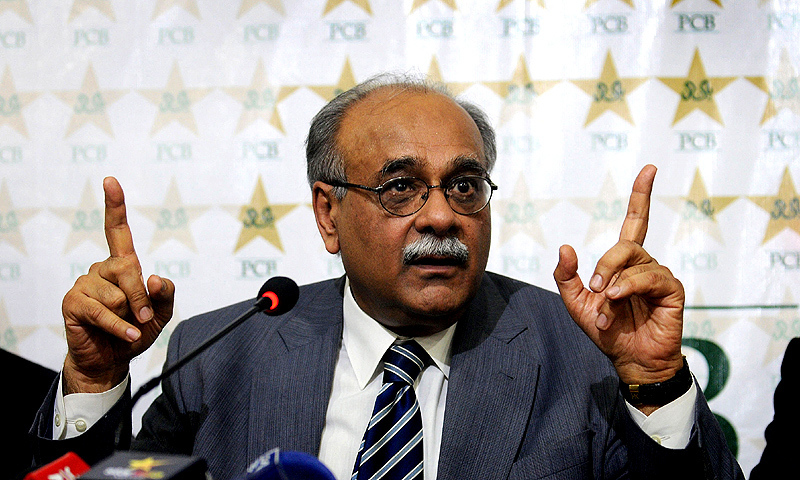
LAHORE: The twice-postponed Pakistan Super League (PSL) will finally be ready for take off in Doha, Qatar, next year, former chairman Najam Sethi announced on Wednesday.
The event is scheduled for February and will feature around 25 foreign players.
The Pakistan Cricket Board (PCB) had planned a Super Twenty20 league in 2013 but had to postpone it twice -- in 2014 and 2015 -- over a lack of response from sponsors and logistics problems.
Sethi, the head of PCB's Executive Committee, announced the PSL will be held from 4-24 February next year.
“The PSL will be held in Doha from February 4-24 with a prize money of one million dollars (100 million rupees) and we are getting encouraging responses from sponsors and foreign players,” said Sethi.
The idea behind staging the league was to give Pakistani players a chance to compete with and against top foreign players, something which the national players do not get as international cricket has been suspended in the country since 2009.
Pakistan was a no go area for international teams since terrorists' attacks on the Sri Lankan team bus in Lahore in March 2009.
This was partially overcome with a short limited-over series against Zimbabwe in May-June this year.
“We are in talks with 40 foreign players and we expect some 25 to sign for the league and out of these 15 will be world class players,” Sethi said of the planned league.
Four West Indians and two players each from Sri Lanka, Bangladesh, Australia, New Zealand, England and South Africa were amongst the targeted names, he said.
Sethi added that no player from India was on the PSL target list as the Board of Control for Cricket in India does not allow its players to feature in a foreign league.
Pakistan was forced to shift the League to Doha after grounds in the United Arab Emirates -- where Pakistan have played all their home cricket since 2009 -- were booked for a private league in January-February 2016.
Published In Dawn News.

Amir Khan visits Lyari in search of boxing champions

KARACHI: British boxer Amir Khan on Wednesday vowed to help Pakistan produce champion pugilists with a network of academies in his family's country of origin.
The former two-time world champion is currently touring the South Asian giant of 200 million people better known for its prowess in cricket, and plans to set up boxing schools in the western Khyber Pakhtunkhwa province, eastern Punjab, and the southern city of Karachi.
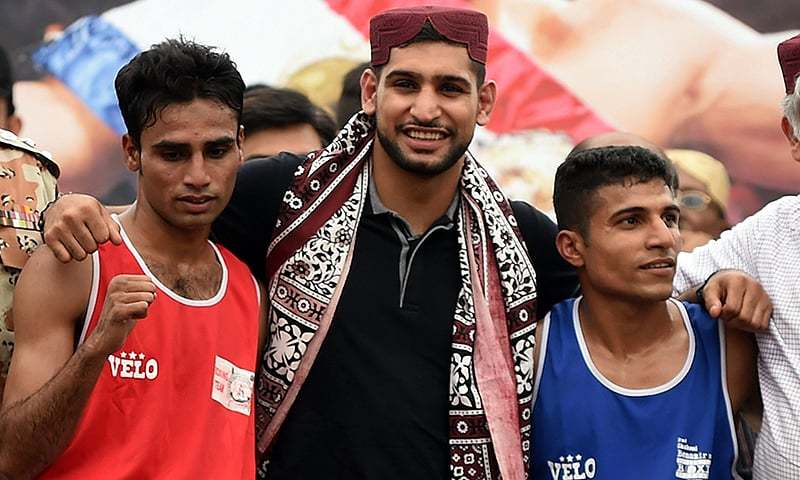
“I think we have the talent to produce boxing champions,” the 28-year-old told media during a visit to Karachi's troubled Lyari area, which is frequently hit by gang violence but also known for producing talented footballers and boxers.
British boxer Amir Khan of Pakistani waves to fans during his visit to the Peoples Football Stadium in Lyari, Karachi. — Reuters
“I have made a promise to the nation that I will pay back what I have achieved in boxing,” added the highly-rated fighter from Bolton, England who has a record of 31 wins including 19 knockouts, and three losses.
Khan was accompanied by a heavy security contingent to the neighbourhood, which has long been a hub of political, ethnic and criminal violence.
“I am here to meet potential champions and I am not afraid of anything, we will... beat terror and produce boxers of top quality,” he said.
Pakistan's sole Olympic boxing medallist is Hussain Shah, who won a middleweight bronze in the Seoul Games in 1988.
The country has also produced an Asian Games gold-medallist in Mehrullah Lassi, who won the featherweight division at Busan, South Korea in 2002.
Khan, who became Britain's youngest Olympic boxing medallist when he won silver at the 2004 Athens Olympics, said he was keen to train Pakistani boxers.
“I will pass my tricks to them and will do my best to help them qualify for the Olympics, if not the 2016 in Brazil then the next one in Japan in 2020,” he said.
Known for his speed and aggressive style, Khan won the last of his fights against US boxer Chris Algieri in New York in May before once again challenging the welterweight world champion Floyd Mayweather.
But Mayweather announced earlier this month he would aim to match the 49-0 career record of the legendary Rocky Marciano in his final bout against fellow American Andre Berto on September 12, effectively ruling out a highly anticipated clash with Khan.
Five-division world champion Mayweather beat Manny Pacquiao of the Philippines in May of this year in what was described as the “fight of the century”.
Published In Dawn News.